Theatre On Skates Academy
Menu
  • External link opens in new tab or window
  • External link opens in new tab or window
  • External link opens in new tab or window
  • External link opens in new tab or window
  • External link opens in new tab or window

Testimonial Articles


Featured Articles


Skating academy helps kids fulfill dreams - Young black males encouraged to take up figure skating

By The Detroit News Rhonda Bates-Rudd March 8, 2000 Publication: Detroit News, The (MI) Page: 12S Word Count: 519

Since the first time he glided across a frozen neighborhood ice puddle in an $11 pair of Sears & Robuck ice-skate specials, Detroit native Michael Orr has been literally skating his way through his dreams.

Orr, 30, is now the proud and happy founder, owner and coach of the newborn Detroit-based Motor City Skating Academy, an ice skating program for youth and teens.
His inspiration, he said, came at age 7 as he sat in front of the television watching Olympic gold medalist Dorothy Hamil glide across the ice.
He subsequently turned to his parents and said, "I want to be a professional skater when I grow up."
"You can't do that," Orr's parents told him.
And when he asked why not, they told him, "Because it's a white man's sport."
If you think that discouraged a young man looking to fulfill his heart's desire, think again.
Orr said he wants to encourage young black males to take up an interest in the sport.
"When I was growing up, there were no African-American role models for me to look up to, but now we have a few, Debbie Thompson, and Rory Flack," Orr said. "There are a few black males, including myself, that aren't in the limelight.
"The Motor City Skating Academy presents me with the opportunity to coach and nurture both male and female students, as well as empower them to move on to professional entertainment or competition athletic skating."
The Motor City Skating Academy currently leases ice arena time at the City Sports Arena on East Lafayette. There currently are 65 students enrolled in a seven-week course that costs $52.50 per student. Students must furnish their own skates.
It costs about $170 per hour to rent and support the upkeep of the ice, and Orr is seeking corporate sponsorship. He said he is willing to talk to anyone who can assist him in securing vacant property that can be renovated into an urban ice arena.
Helena Scott is the founder of Detroit-based Elite Figure Skaters International, an ice skating organization she created after her children, Samantha, 9, and Ricky, 11, took an interest in figure skating. The young Scotts are members of the Motor City Skating Academy.
"It can be a very expensive sport, and financially many parents don't have access to the financial means needed to support their children in competition skating because it requires a lot of travel," Scott said. "Elite Figure Skaters International is a nonprofit organization that opens the door for corporate sponsors and individuals to support the skaters tax free.
"But more importantly, it is an opportunity for the community to rally behind the kids and give them a chance at materializing their dreams of someday making it to the Olympics."
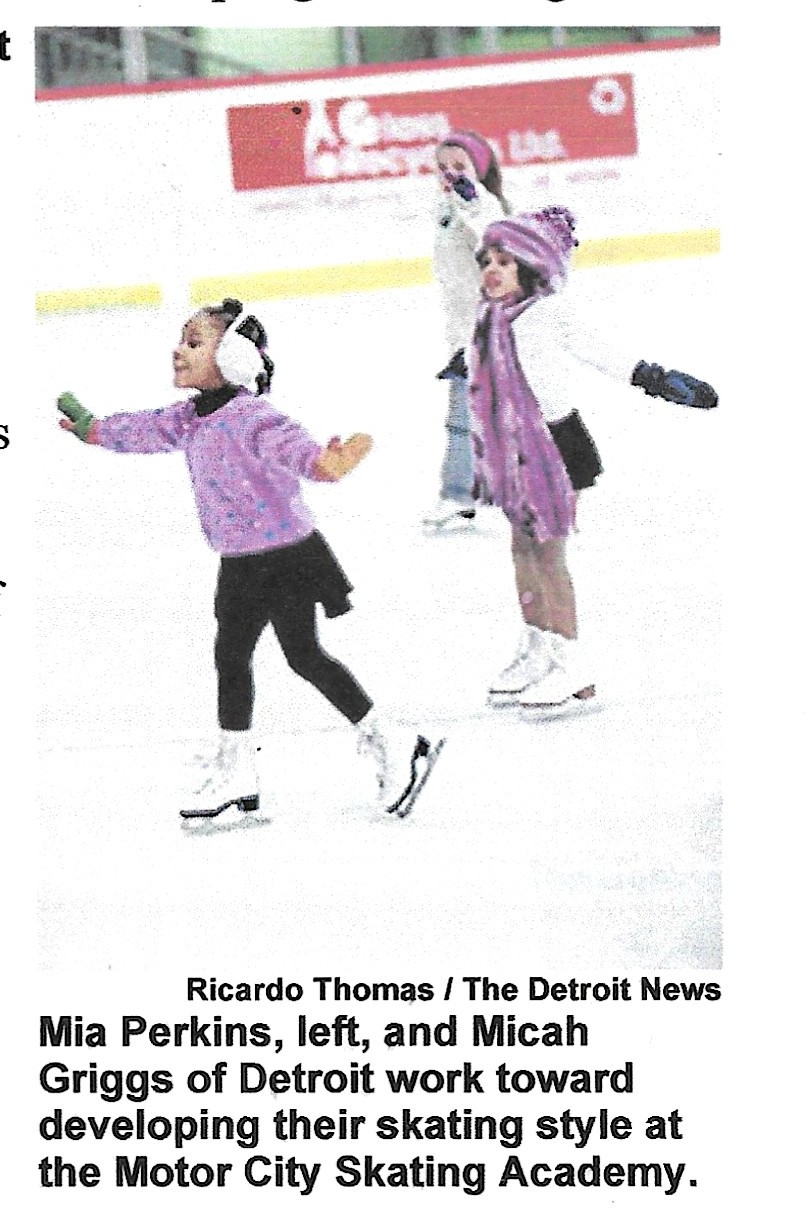
For information on the Motor City Skating Academy, call Michael Orr at (313) 294-0552. Call Helena Scott of the Elite Figure Skaters International at (313) 864-4076 or write P.O. Box 32968, Detroit, Mich. 48232-9995.Mia Perkins, left, and Micah Griggs of Detroit work toward developing their skating style at the Motor City Skating Academy. Skating instructor Michael Orr, left, shows Detroiter Renee Scott the proper posture to use during her skating routine.Detroit News, The (MI)Date: March 8, 2000Page: 12SCopyright (c) The Detroit News. All rights reserved. Reproduced with the permission of Gannett Co., Inc. by NewsBank, inc.


The Detroit News


More Testimonials


Column

Figure skaters get their day on ice

By Steve Pardo The Detroit News May 3, 1999 Publication: Detroit News, The (MI) Page: 6D Word Count: 185

DETROIT -- It was blue skies on the outside and new skies on the inside at the Jack Adams Ice Arena on Sunday.

More than 50 figure skaters, nearly all Detroiters, performed in the grand finale of the Renaissance Figure Skaters Spring Ice Show, titled Under New Skies. The skaters ranged from 3 years old to 18.

The ice center provides an outlet for figure skating in the city and is one of a handful of predominantly African-American figure skating arenas nationwide.

"We're trying to more or less bring figure skating back into the African-American community to encourage the young ladies and men that there's more than basketball and football out there," said Sam Watkins, president of the center's Renaissance Figure Skater's Club.

The show featured the standout brother-and-sister team of Samantha Scott, 8, and Ricky Scott, 10. The pair plan on taking their talents all the way to the top, said their mother, Helena Scott.

"They both say they want to go to the Olympics," she said, while helping a group of girls get into their Broadway-style costumes before Sunday's opening act. "It's a huge commitment."Detroit News, The (MI)Date: May 3, 1999Page: 6DCopyright (c) The Detroit News. All rights reserved. Reproduced with the permission of Gannett Co., Inc. by NewsBank, inc.


The Detroit News

Column

External link opens in new tab or windowArts & Culture


Ice Dreams

Hoping for stardom, melting

 rinkside sterotypes.


External link opens in new tab or windowMetro Times editorial staff
April 28, 1999

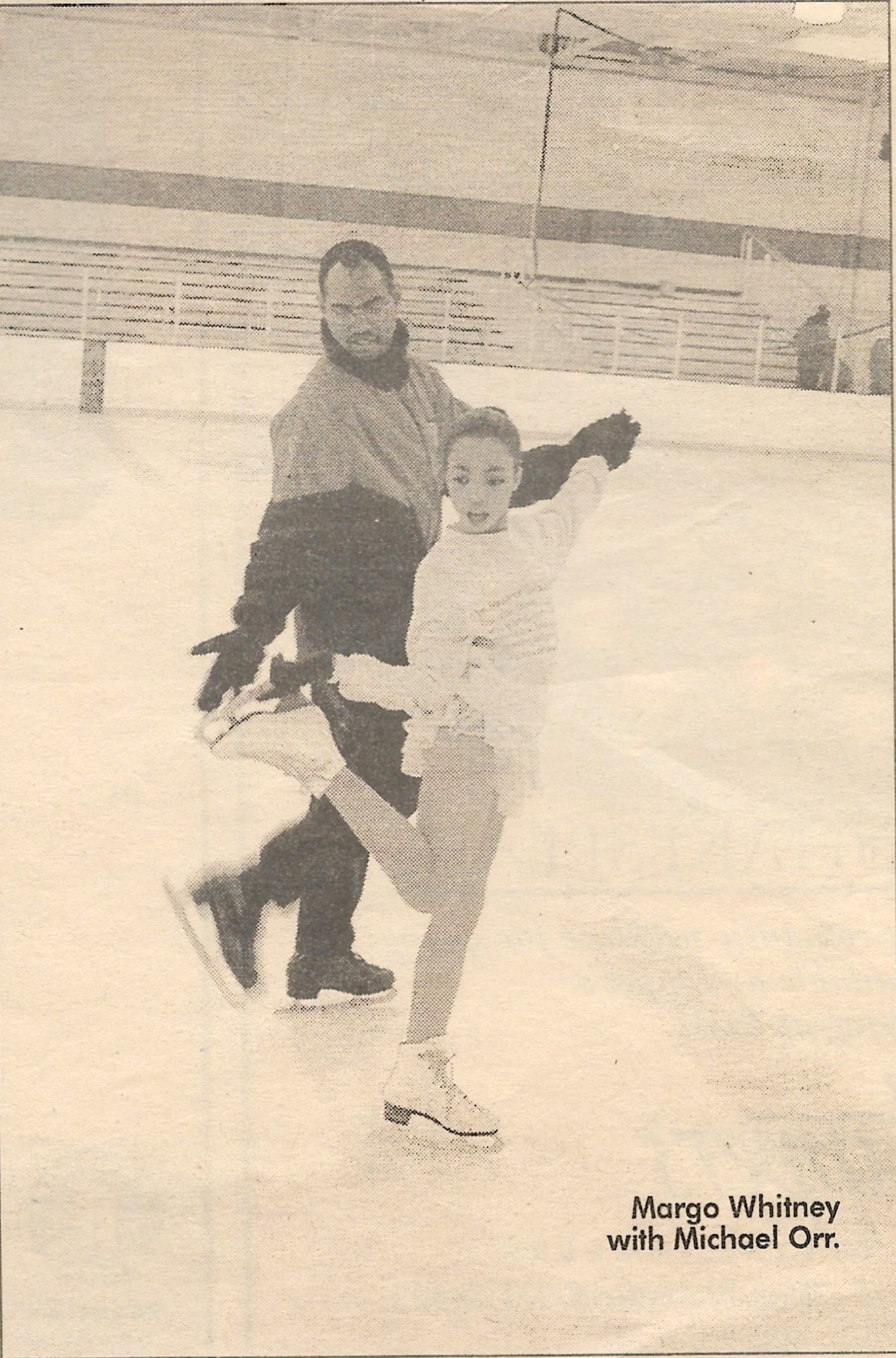
Ten-year-old Margaux Whitney has been figure skating since she was 3. The many medals she has won hang on her bedroom walls along with photos of Olympic skaters, including her favorite, Oksana Baiul.

A fourth-grader at Detroit’s Bates Academy, Margaux skates six days a week. She also plays the violin, sings with a youth choir and competes in academic games.

“She does her homework in the car or at the rink,” says her mother, Robin Whitney.

On the ice, Margaux is serious, poised and graceful beyond her years. Off the ice, she becomes a typical 10- year-old again. “Watch me, Mommy,” she implores. “I’m going to do six loops.”

Margaux skates with the Renaissance Figure Skaters, a Detroit-based club, and will perform as a soloist in the club’s ice show this weekend.

For Margaux, the performance is yet another step up. This year, she tested into the United States Figure Skating Association’s “preliminary” category in free-skating and the “pre-juvenile” in moves-in-the-field. These levels are about halfway up the USFSA’s competition structure, which eventually qualifies skaters for the Olympics.

“I’d like to go to the Olympics one day,” Margaux says. She knows how to do it: “Just keep moving up through the regionals, and the nationals, and the world.”

Interest in figure skating has boomed in recent years, and metropolitan Detroit is well known for Bloomfield Hills’ Detroit Figure Skaters club where Olympic champions Tara Lipinski and Todd Eldridge trained.

But in the African-American community, figure skating is just beginning to gain popularity. When skater Debi Thomas won Olympic bronze in 1988, she became the first and only African-American to win a medal not just in skating, but at the Winter Olympics.

The expense of skating, the typically suburban location of rinks, and limited exposure to winter sports are cited to explain the scarcity of African-American skaters.

When Margaux’s coach, Michael Orr, was growing up, he told his grandparents that he wanted to skate.

“They told me ‘No. It’s a rich man’s sport. It’s a white man’s sport,’” he recalls. Orr got a paper route and paid his own way.

“A friend told me I could buy ice skates at Sears for $9,” Orr says. “I used to take the West Chicago bus to Greenfield and then take the Greenfield bus all the way down to Fairlane Ice Arena. I’d skate from 6:30 to 9:30 and then take the bus home. I was 11-and-a-half. My grandparents left the back door open, and dinner was on the stove.”

Orr recalls competing in the nationals in 1994. “Just to be there means that you’re one of the best skaters in the country,” he says.

“When I look back on it, I think I did accomplish a lot. Especially being an Afro-American, because there are not that many Afro-American skaters.”

Orr is now the director of the Renaissance Figure Skaters, which has its home at Jack Adams Arena on Detroit’s northwest side. He also teaches and coaches at the Novi Ice Arena.

“I wanted to give back something I needed but didn’t get when I was coming up,” Orr says. “It’s important for kids to have somebody of their own background who’s been there.”

The 60-member club is 95 percent African-American.

Orr recognized Margaux’s talent and began coaching her when she was 8. “She’s come so far in such a short time,” he comments.

Robin Whitney says it takes a huge commitment from family and friends so Margaux can skate.

“At first people didn’t understand. If I talked about skating, people assumed I meant roller skating,” she says.

Keith Whitney, Margaux’s dad, is a minister at Sanctuary Fellowship in Detroit, and Robin is a secretary at a church in Ferndale. Most of Robin’s salary goes toward skating.

“People have been so kind,” Robin says. Sometimes a member of the church will pay for a costume, or a friend who owns a business will sponsor a competition. This year Margaux’s grandmother paid for her ice skates, which cost $600.

“And you can’t get them big and grow into them,” Margaux cautions. She needs a new pair every year.

Robin Whitney has never added up the cost. “I don’t want to know,” she says.

But she can readily itemize: Coaching fees — $250 a month, year-round. Club membership and ice fees — $350 a year at Renaissance, and in order to get enough ice time, Margaux also skates in Novi ($500 a year) and Farmington Hills ($300 a year). Ballet lessons twice a week are $90 a month and private on-ice ballet coaching is $100 a month. Entering a competition costs $75, and Margaux enters five or six a year. Sometimes travel expenses are involved. Testing is $50 twice a year. And this year, she spent $375 for costumes — one had $60 worth of sequins.

“I want to be able to provide the means for her to go as far as she wants to go,” Robin Whitney says. “If she wants to do it, I don’t want to have to say to her that we can’t afford it.”

For her part, Margaux works hard, currently focusing on her jumps. The most difficult jump she can land is the double Salchow, an edge jump named after Ulrich Salchow. Her next hurdle is the double loop, while she considers the double toe the hardest.

© 2026 Detroit Metro Times

Powered by Newspack

“You start on the inside edge, you turn on that edge, you stick your toe in, and you have to hoist yourself around and complete two rotations, and land on the outside edge,” she explains.

In competition, she can get nervous. “The judges never smile,” she notes. “You don’t want to slip because they’ll go write it down as soon as you do.”

Once in a while, she doesn’t feel like skating. “Some days it just doesn’t click,” she says. But most days there is magic to it.

“I like the feel of the ice,” she says. “It’s like being on a slippery floor. But you can glide across the ice and do all kinds of moves and steps.”

And after the Olympics? “I’d like to become a violinist. I love Mozart.”


External link opens in new tab or windowMetro Times editorial staff

Column


External link opens in new tab or windowArt on the Air, January 11, 2026

This Week on ART ON THE AIR features Michigan City’s Theatre On Skates Academy founder, Michael Orr, singer/songwriter Robert Deeble sharing his seventh album, “The Space Between Us” to be released of his February 2026, Spotlight on the Center for Creative Solutions 17th World Creativity Week and the 10th annual Poetry Showcase.


Lakeshore Public Media - Art on the Air

close lightbox